
Technological improvement over the year has contributed immensely to the enhancement of quality of life through various new products and services. One such revolution was the pre engineered buildings. Through its origin can be traced back to 1960’s its potential has been felt only during the recent years. This was mainly due to the development in technology, which helped in computerizing the design and design.
Though initially only off the shelf products were available in these configurations aided by the technological development tailor made solutions are also made using this technology in very short durations. A recent survey by the Metal Building Associations (MBMA) shows that about 60% of the non residential low rises building in USA are pre engineered buildings.
Although PEB systems are extensively used in industrial and many other non residential constructions world wide, it is relatively a new concept in India. These concepts were introduced to the Indian markets lately in the late 1990’s with the opening up of the economy and a number of multi nationals setting up their projects.The market potential of PEB’s is 1.2 million tones per annum. The current pre engineered steel building manufacturing capacity is 0.35 million tones per annum. The industry is growing at the compound rate of 25 to 30 %.
With respect to design of the structure and aesthetic appearance India is way behind. Indian manufacturers are trying to catch up; comparatively PEB’s is a new concept in India. Beside, in fabrication and other areas of PEB India is very good. As compared to other countries Indian codes for building design are stringent but safer. IS standards are upgraded continuously. In India, American codes are also followed.
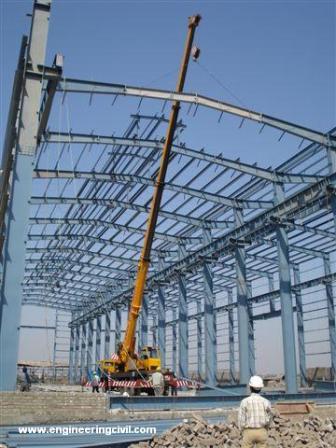
Pre engineered steel buildings can be fitted with different structural accessories including mezzanine floors, canopies, fascias, interior partitions etc. and the building is made water proof by use of special mastic beads, filler strips and trims. This is very versatile buildings systems and can be finished internally to serve any functions and accessorized externally to achieve attractive and unique designing styles. It is very advantageous over the conventional buildings and is really helpful in the low rise building design.
Pre engineered buildings are generally low rise buildings however the maximum eave height can go upto 25 to 30 metres. Low rise buildings are ideal for offices, houses, showrooms, shop fronts etc. The application of pre engineered buildings concept to low rise buildings is very economical and speedy. Buildings can be constructed in less than half the normal time especially when complemented with the other engineered sub systems.
The most common and economical type of low rise buildings is a building with ground floor and two intermediate floor plus roof. The roof of low rise buildings may be flat or sloped. Intermediate floors of low rise buildings are made of mezzanine systems. Single storied houses for living take minimum time for construction and can be built in any type of geographical location like extreme cold hilly areas, high rain prone areas, plain land obviously and extreme hot climatic zones as well.
Applications of Pre Engineered Buildings (PEB)
1. WAREHOUSES
2. FACTORIES
3. WORKSHOPS
4. OFFICES
5. GAS STATIONS
6. VEHICLE PARKING SHEDS
7. SHOWROOMS
8. AIRCRAFT HANGARS
9. METRO STATIONS
10. SCHOOLS
11. RECREATIONAL
12. INDOOR STADIUM ROOFS
13. OUTDOOR STADIUM CANOPIES
14. BRIDGES
15. RAILWAY PLATFORM SHELTERS
Advantages of Pre Engineered Buildings
REDUCED CONSTRUCTION TIME: Buildings are typically delivered in just a few weeks after approval of drawings. Foundation and anchor bolts are cast parallel with finished, ready for the site bolting. Our study shows that in India the use of PEB will reduce total construction time of the project by at least 50%. This also allows faster occupancy and earlier realization of revenue.
LOWER COST: Due to the systems approach, there is a significant saving in design, manufacturing and on site erection cost. The secondary members and cladding nest together reducing transportation cost.
FLEXIBILTY OF EXPANSION: Buildings can be easily expanded in length by adding additional bays. Also expansion in width and height is possible by pre designing for future expansion.
LARGE CLEAR SPANS: Buildings can be supplied to around 80M clear spans.
QUALITY CONTROL: As buildings are manufactured completely in the factory under controlled conditions the quality is assured.
LOW MAINTENANCE : Buildings are supplied with high quality paint systems for cladding and steel to suit ambient conditions at the site, which results in long durability and low maintenance coats.
ENERGY EFFICIENT ROOFING AND WALL SYSTEMS: Buildings can be supplied with polyurethane insulated panels or fiberglass blankets insulation to achieve required “U” values.
ARCHITECTURAL VERSTALITY: Building can be supplied with various types of fascias, canopies, and curved eaves and are designed to receive pre cast concrete wall panels, curtain walls, block walls and other wall systems.
SINGLE SOURCE RESPONSIBILTY: As the complete building package is supplied by a single vendor, compatibility of all the building components and accessories is assured. This is one of the major benefits of the pre engineered building systems.
No comments:
Post a Comment